
Security Tips • 18 November 2026
Sindh Online Domicile Rollout: Why Karachi Citizen Facilitation Desks & DC Offices Need High-Definition Counter CCTV
With Sindh launching online domicile and residence certificate services for Karachiites, public offices and digital desks require specialized counter-level CCTV surveillance.
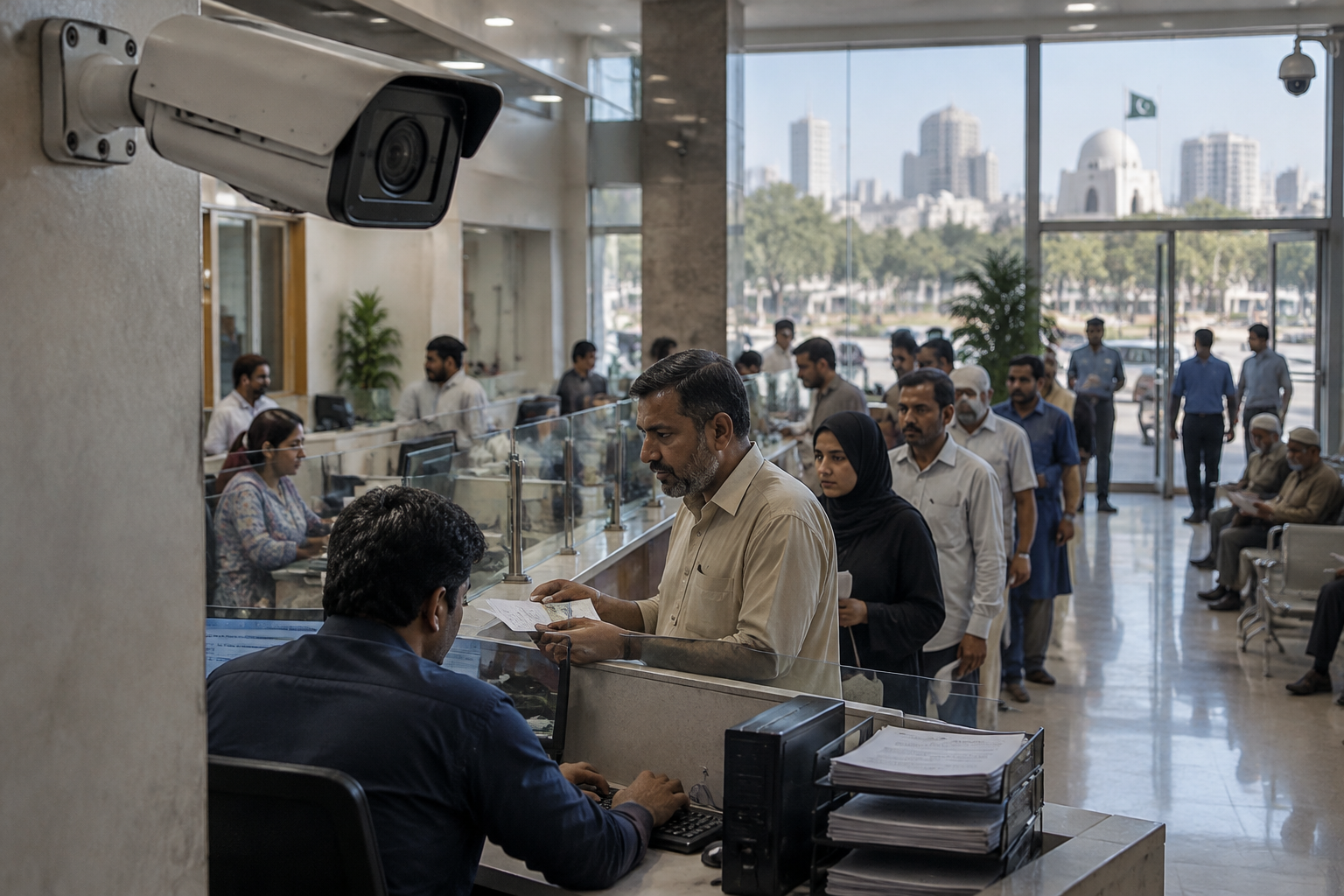
High-volume citizen facilitation centers, public record verification desks, and municipal offices in Karachi require 4MP or 5MP indoor dome IP cameras equipped with built-in audio, 120dB True WDR, and narrow overhead focal positioning. Installing transaction-level surveillance over service counters deters bribery, resolves public disputes, verifies document exchanges, and preserves an unalterable digital audit trail across Karachi district complexes.
What does the online domicile rollout mean for Karachi public facilitation offices?
The Government of Sindh recently initiated an online domicile and residence certificate issuance system to facilitate residents across all administrative districts of Karachi, including District South, East, Central, West, Korangi, Malir, and Keamari. While the portal digitizes application submissions, citizens must still interface with physical processing hubs, verification counters, and digital kiosks established within Deputy Commissioner (DC) offices, e-Khidmat centers, and regional administrative branches for biometric capture, physical document scrutiny, and affidavit validation.
Historically, public service counters in busy Karachi hubs like Saddar, North Nazimabad, Gulshan-e-Iqbal, and Shah Faisal Colony experience heavy civilian footfall, prolonged waiting queues, and occasional friction between clerical staff and applicants. With new e-governance kiosks handling national identity cards, academic credentials, and official utility records, administrative supervisors face the critical operational challenge of securing these transaction spaces against unauthorized agents, bribery allegations, paper record misplacement, and physical altercations. Installing dedicated commercial CCTV installation Karachi systems at document intake counters is now a functional necessity for institutional accountability.
Why do transaction desks and document verification counters require dedicated CCTV?
General perimeter cameras mounted in waiting halls or exterior corridors cannot capture what transpires across a service window. When an applicant hands over original matriculation certificates, PRC documents, utility bills, or fee receipts, standard ceiling-mounted wide-angle lenses produce blurry, unreadable overviews. Transaction desks require focused, localized camera geometry for several distinct reasons:
First, document exchange verification prevents lost-record disputes. Citizens frequently claim they submitted original supporting files, while processing clerks report missing attachments. A high-resolution security camera Karachi focused downward on the counter surface captures an undeniable visual record of every paper, token, and envelope passed across the partition.
Second, counter-level security prevents unauthorized touts and agents from lingering near workstations. In busy civic offices across Saddar and Korangi, touts often exploit crowded rooms to approach frustrated applicants. High-definition surveillance helps floor managers identify repeated unauthorized individuals soliciting fees on state property.
Third, audio-enabled monitoring safeguards frontline staff against aggressive confrontations and false accusations. When disputes arise over eligibility criteria, queue order, or domicile quotas, synchronized audio-video evidence clarifies whether administrative staff maintained professional protocol or if a civilian violated civil order.
Which camera specifications work best for Karachi public counters and e-desks?
- 4MP or 5MP Turret Dome IP Cameras: Turret dome housings offer tamper resistance and discreet indoor aesthetics without internal glass reflections. A 2.8mm to 4mm fixed lens positioned 7 to 8 feet above the counter captures both the applicant's facial profile and the desktop workspace.
- True WDR (120dB) for Indoor Glare Control: Most public facilitation offices in Karachi feature large glass windows or bright entrance doorways opposite processing counters. Standard digital WDR (DWDR) causes subjects to appear as dark silhouettes against sunlit backdrops. Hardware True WDR balances extreme exposure differences, keeping facial features and paperwork fully discernible.
- High-Sensitivity Built-in Microphones: Modern IP cameras from reputable manufacturers like Hikvision and Dahua feature built-in noise-filtering microphones that capture spoken exchanges at counter partitions without picking up background ambient noise from packed waiting halls.
- Narrow Focal Alignment over Cash and Biometric Stations: Where bank challans, biometric fingerprint scanners, or webcams operate, motorized varifocal cameras zoomed to 6mm or 8mm allow supervisors to audit screen interactions, stamping procedures, and card issuance without intrusive overhead hardware.
How should Karachi administrative facilities design NVR recording and server security?
A surveillance system is only as dependable as its recording backbone. In public facilities across Karachi, where voltage drops, load-shedding, and dusty ambient environments are routine, video infrastructure requires structured engineering. Network Video Recorders (NVRs) must be housed in dedicated, locked server cabinets located inside climate-controlled control rooms with restricted biometric or digital card access, preventing unauthorized tampering or manual cable disconnection.
To sustain evidentiary compliance, citizen service centers should configure H.265+ video encoding combined with enterprise-grade surveillance hard drives (such as Western Digital Purple or Seagate SkyHawk). These drives withstand 24/7 continuous write cycles, storing a minimum of 45 to 60 days of continuous multi-channel footage. In facilities subject to K-Electric outages, pairing NVRs and PoE network switches with high-capacity pure sine wave online UPS systems ensures uninterrupted coverage during generator switchover delays.
What is the commercial CCTV camera price Karachi for service centers and offices?
When budgeting for professional office and institutional surveillance in Karachi, pricing depends on whether the installation uses basic analog HD components or commercial-grade IP network infrastructure. For document centers, municipal offices, and corporate customer desks, IP systems provide the essential resolution and networking flexibility needed for central monitoring.
A basic 4-camera 2MP IP setup with built-in audio, 4-channel PoE NVR, and a 2TB surveillance hard drive generally starts between PKR 65,000 and PKR 85,000, including basic Cat6 cabling. For larger 8-camera commercial setups featuring 4MP or 5MP True WDR turret domes, an 8-channel PoE NVR, 4TB storage, and pure copper Cat6 networking, the total CCTV camera price Karachi ranges between PKR 135,000 and PKR 185,000 depending on cable runs and conduit requirements. High-end 16-camera deployments designed for multi-floor government complexes or corporate facilitation plazas in locations like Shahrah-e-Faisal or Clifton typically range from PKR 260,000 to PKR 375,000, incorporating motorized varifocal lenses, managed PoE switches, and rack-mount server cabinets.
Why professional planning matters when searching for CCTV installation near me
Improper camera positioning is the most frequent flaw in office surveillance across Karachi. Untrained technicians often mount wide-angle cameras high on ceiling corners, capturing useless top-of-head views of applicants and completely missing desktop document handovers. Over a decade of field experience at CCTVKarachi.com under Babar Khan Lodhi has demonstrated that transaction monitoring requires precise angle calculations, calculated lens focal lengths, and isolated data networks to ensure foolproof security.
Public and private administrators searching for CCTV installation near me must partner with experienced technicians who understand Karachi's unique operational realities—from shielding Cat6 runs against electrical conduit interference to properly grounding metal server racks against voltage surges. Correct installation guarantees that surveillance serves its true purpose: transparency, security, and ironclad operational integrity.
Frequently Asked Questions
- Why is True WDR essential for citizen desks in Karachi offices? — Most public facilitation centers feature bright exterior entryways or glass partitions facing indoor counters. Without 120dB True WDR, sunlight behind the citizen renders their face completely dark and unusable for identification on recorded footage.
- Can counter CCTV record audio legally in Karachi service centers? — Yes, commercial and public offices routinely deploy audio-enabled surveillance over customer service desks for quality assurance, dispute settlement, and anti-corruption compliance, provided standard notices indicating video and audio surveillance are displayed.
- What hard drive capacity is needed to store 30 days of counter footage? — For an 8-camera 4MP IP system utilizing efficient H.265+ compression, a 4TB surveillance-grade hard drive typically stores between 25 and 35 days of continuous 24/7 recording, depending on frame rate settings.
- How do PoE switches simplify CCTV installation in large public plazas? — Power over Ethernet (PoE) switches transmit both power and high-speed data across a single Cat6 network cable directly to each IP camera, eliminating the need for independent 12V electrical sockets and messy power adapters near service counters.
CCTV Installation in Karachi Areas
Planning a camera installation for your home, shop, or street? Babar Khan Lodhi's team provides a free on-site survey across all of Karachi — reach out on WhatsApp.